
Aircon Gas Top-Up Singapore — Leak Detection First
Refrigerant top-up with leak detection first — because a sealed system shouldn't need gas unless there's a leak.
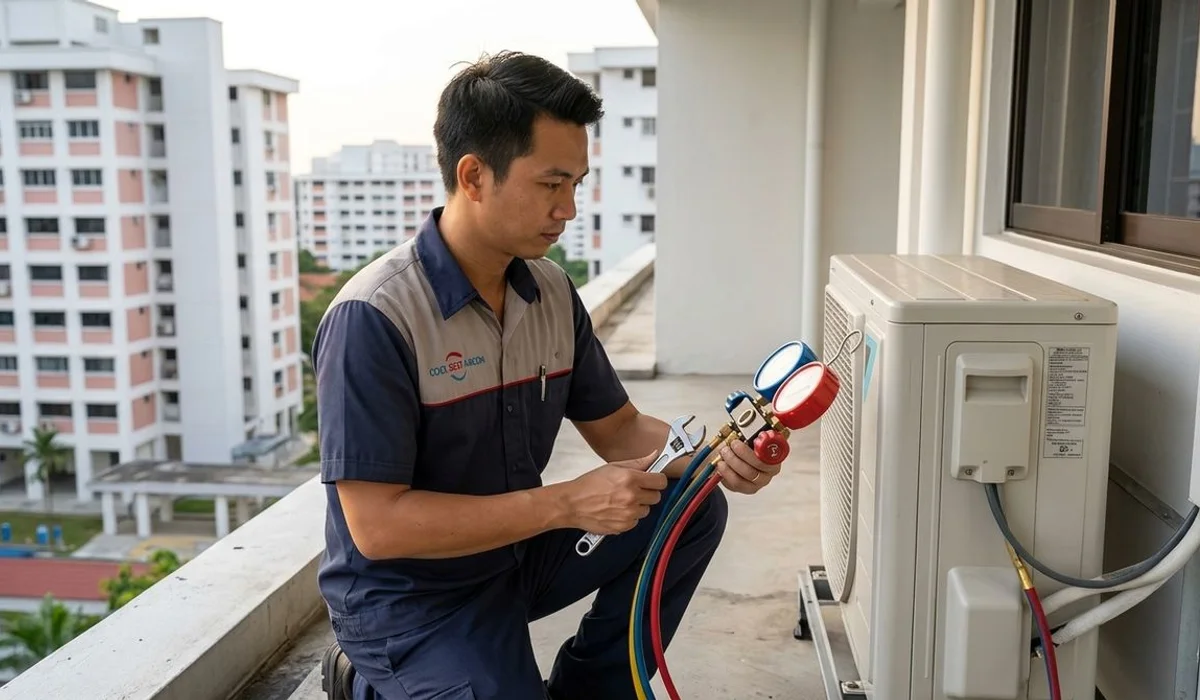
Signs Your Aircon Is Low on Refrigerant
Refrigerant doesn’t get “used up” — if your aircon is blowing warm air, there’s a problem:
Aircon blowing warm air despite a clean filter and coil. If the unit runs constantly but never reaches set temperature, low refrigerant is a likely cause. A properly sealed system should maintain cooling indefinitely.
You’ve been getting gas top-ups every few months from another company. If you’ve had three or more top-ups in a year, you have an active leak that was never fixed. Each top-up without leak detection is throwing money away.
You can hear hissing or bubbling near the indoor or outdoor unit. These sounds indicate refrigerant escaping under pressure — a audible leak that’s costing you money and will eventually leave the unit running but not cooling.
The copper piping or flare connections look corroded or stained. Blue-green staining on copper connections near the outdoor unit is a sign of refrigerant weeping — a slow leak that will eventually become a fast one.
Your electricity bill spiked without a corresponding increase in usage. An aircon with low refrigerant runs longer and works harder to achieve the same cooling — and your SP Group bill reflects it.
Why We Insist on Leak Detection First
Here’s an uncomfortable truth about aircon gas top-ups: a sealed aircon system shouldn’t lose refrigerant. If your unit is low on gas, there’s a leak — full stop.
Too many operators top up without checking. You get cold air back for 4–6 weeks, then it fails again, and the cycle repeats. You pay for gas twice or three times a year when you should pay once, and fix the leak once.
At Coolbest, we do leak detection first. Every time.
How we find leaks
- Soap bubble test — for visible flare joints and service valves
- Electronic sniffer — picks up refrigerant vapour at low concentrations
- Pressure test — pressurises the system and monitors for pressure drop over time
Most leaks turn up at:
- Flare nut connections (indoor or outdoor unit) — the most common leak point, easily re-flared and tightened
- Copper piping — if the piping was damaged during wall installation or kinked, we repair or replace the affected section
- Evaporator coil (inside the fan coil) — the worst case. Sometimes warrants replacing the whole indoor unit.
Refrigerant Types We Handle
| Refrigerant | Era | Common Brands |
|---|---|---|
| R22 (HCFC) | Pre-2010 | Older Daikin, Panasonic |
| R410A | 2010–2018 | Mid-generation inverters |
| R32 | 2018–present | New Daikin, Mitsubishi, Toshiba |
We carry all three and charge to manufacturer spec using calibrated scales and pressure gauges. Overcharging is as bad as undercharging — it stresses the compressor and shortens life.
What a Proper Top-Up Looks Like
- Pressure test to find the leak
- Repair the leak (flare, copper section, or component)
- Evacuate the system with a vacuum pump (removes air and moisture)
- Charge to the manufacturer’s spec weight
- Verify with outlet temperature and pressure gauge readings
Skip any of these steps and you’re buying a fix that won’t last. Our 90-day workmanship warranty covers the leak repair and top-up — if the fix fails within 90 days, we return at no charge.
Our Process
Leak Check
Before topping up, we check for leaks with soap test, electronic sniffer, and pressure test. Skipping this means wasting money.
Repair the Leak
If a leak is found (copper piping, flare nut, or evaporator), we repair it first. Topping up without fixing the leak is throwing gas away.
Evacuate + Charge
We evacuate air and moisture from the system with a vacuum pump, then charge to manufacturer spec with the correct refrigerant.
Performance Test
Pressure reading verification, outlet temperature test, and cooling performance check across all indoor units.
Common Questions
Why do I need leak detection before a gas top-up?
+
What refrigerant does my aircon use?
+
Is R22 gas still available in Singapore?
+
How long does a gas top-up last?
+
Related Guides
Deep dives on gas top-up.
How Often Should Aircon Refrigerant Be Topped Up?
A properly sealed aircon should never need refrigerant top-up. If you're paying for it every 1–2 years, you have a leak — here's what to do.
Signs Your Aircon Needs Gas Top-Up (And Why It Shouldn't Be Often)
Ice on copper pipes, weak cooling that doesn't respond to servicing, hissing sounds — real signs of low refrigerant, plus the common upsell myths.
Ready to Book Your Aircon Service?
WhatsApp us for same-day slots, transparent pricing, and a 90-day warranty.